Friday, 12 July 2013

What price do we put on a life?


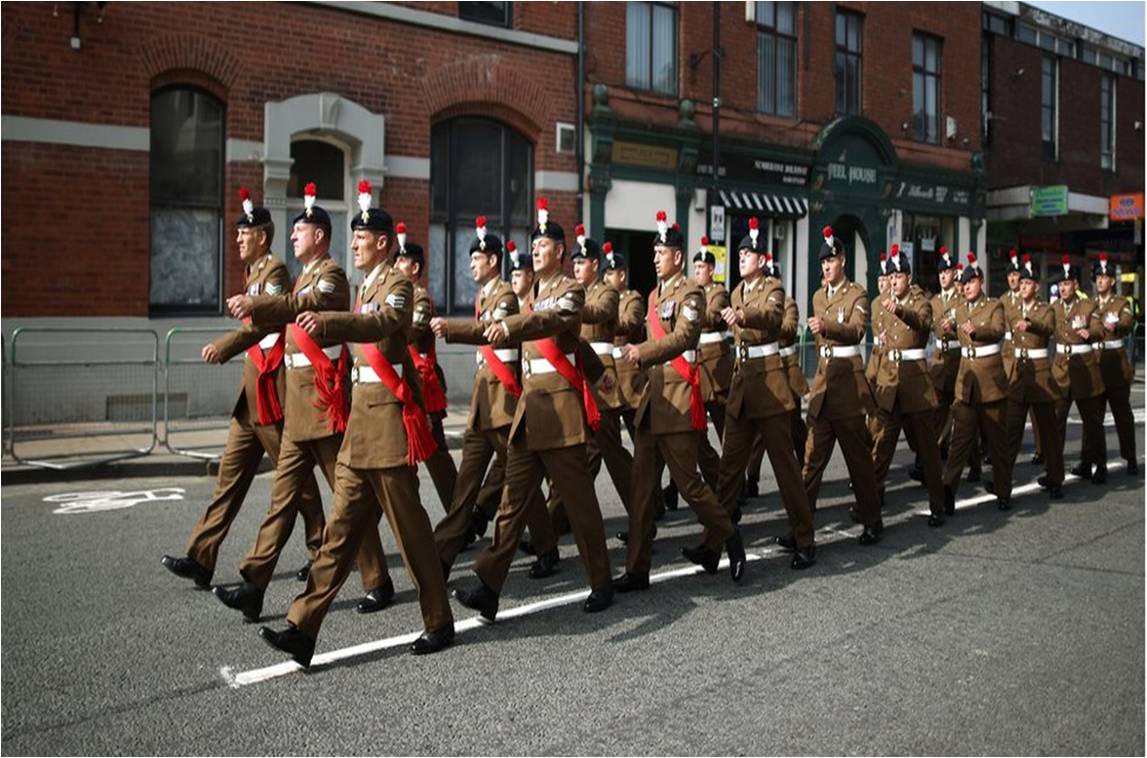
Picture taken from the BBC News website
In Bury, Lancashire, the funeral has taken place of Fusilier Lee Rigby. This was not the funeral of another soldier killed in a foreign land whilst serving his country. This was the result of a horrific attack upon the streets of London, as the soldier returned to the barracks in Woolwich. The large crowd around the church where the service took place is an indication of the sympathy felt for the family, and the outrage at the people who could commit such an atrocity.


For some there may be the genuine question about “religion” that motivates people to kill. Whether it is so-called Muslims who murder Christians, or so-called Christians who murder Muslims, there is nothing that can be used to justify such actions. The Bible says, “Thou shalt not kill”. This was one of God’s direct commandments.  Many Christians refused to take up arms in the Second World War because of their faith.  But shouldn’t we rather be concerned that 551 homicides (including murder, manslaughter, and infanticide) were reported in the year ending December 2012? Is this particular case a reminder that we are beginning to think that life is cheap?


The Bible reminds us of God’s valuation on life. The words of Jesus Christ are clear: “What shall it profit a man if he gain the whole world and lose his own soul?” You cannot put a price on a life! Your life and your eternal destiny are of the utmost importance. God gave His own Son to die on a Roman cross to provide your salvation from sin. He was prepared to sacrifice all that He had for you – that is the price he puts on your life and your soul! You are infinitely precious to God. What is your response? Will you trust Him with your life, or will you reject Him?

Monday, 17 June 2013

‘I spy with my little eye . . .’


Who is watching and listening? Whether it be GCHQ or other organizations intent on maintaining national security, it has been interesting to watch and read the stories of covert surveillance. It seems our emails, our text messages, our tweets, and other modes of electronic communication are all a lot more open than perhaps we have thought. Perhaps that is a frightening thought. How much of what we say and do is private anymore? How much of our daily life is being observed by CCTV?


Some might argue that in the interests of the safety of us all that is a small price to pay. If we are law-abiding citizens, what have we to fear? Others, concerned about civil liberties, might argue that this observation is obtrusive and unnecessary.


All this made me think of a verse from the Bible: ‘Neither is there any creature that is not manifest in his sight: but all things are naked and opened unto the eyes of him with whom we have to do’. There is a surveillance system far more sophisticated than anything that man has invented. God is watching and recording our lives. He is taking stock of what we say and what we do. What might escape the observation of men and women will not escape the eye of God. One day we will be held to account! That is frightening!


However, there is an opportunity to remove that burden of guilt. What we have done can be forgiven and its stain removed. God is able and willing to forgive us our sin and guilt. Sit down and count up what a mass of things we each need to be forgiven for. Yet, through the death of God’s Son, the Lord Jesus Christ, we can find forgiveness. If we are prepared to accept that He died for our sin, my sin to make it personal, then we can be forgiven. Either we bear the consequences of our own deeds, or we accept Christ as our sin-bearer. What is your choice?

Thursday, 30 May 2013

Guilty


http://www.itv.com/news/wales/topic/mold-crown-court/
The jury in Mold Crown Court has arrived at a unanimous verdict in the case of the abduction and murder of a five-year-old girl April Jones. They have found the defendant guilty, and all now await the sentencing of the man responsible.

 
As we were on holiday in South Wales at the time, we can remember the prolonged searches that were features on the news at the time. As the hours and days passed, so hope began to fade that the little girl would be found alive. Indeed, her body has never been found and the precise manner of her death remains unknown.


The untimely death of a child, particularly in this manner, is something that challenges us all. We can’t imagine the heartache of a parent whose child is taken. We can’t really appreciate what it means to maintain hope and yet find it dashed when someone is charged with that child’s murder. Neither can we begin to understand what motivates a person to take a life, especially the life of such a young child. How do we explain it?


Atheists may question the existence of God when, as they see it, He fails to intervene and prevent such senseless killing. However, this avoids the really searching question – what is it in the human character that causes us to be capable of such dreadful acts? God says of man’s heart – your heart and mine – that it is “deceitful . . . and desperately wicked”. What is alarming is that the potential is in us all! We are sinners. History demonstrates that sad conclusion.


But what of this God of love? The real display of God’s love was seen in the death of His Son, Jesus Christ. As the Father watched the cruel treatment meted out by humans upon His Son when He was crucified some 200 years ago, He did not intervene. Indeed, the Bible tells us that God made to meet “upon him the iniquity of us all”. In order that we might be forgiven the Lord Jesus Christ died at Calvary. Could we forgive the person who murdered our child? Yet God is prepared to forgive us in spite of our sin and guilt provided we acknowledge our guilt and turn to Him in faith.

Monday, 13 May 2013

A “humbling and sobering experience”


Image taken from http://www.independent.co.uk/
These were the words of the former Liberal Democrat MP, Chris Huhne. As he was released from prison today, he repeated his apology. Although he has only served a quarter of his sentence, it would seem that the former MP has learnt quite a lot during his time away. Humility may be a part of the lesson.

A dictionary definition of humility is: “having or showing a sense of lowliness or inferiority, modest”. We are all aware of those who fit the opposite definition. It is easy to tell people of your good points. Everybody likes praise, and some people like to sing their own praises! There are plenty of people who have a high opinion of themselves. The really hard thing is to admit you were wrong. As the song lyrics say, “sorry seems to be the hardest word”.

The Bible says quite a lot about humility. James wrote, “Humble yourselves in the sight of the Lord, and he shall lift you up”. What does this mean? One of the things that we need to do is to admit that God is right and we are wrong. When God’s word, the Bible, says that we are sinners – those that have done wrong – how do we react? Do we protest? Do we try and argue our case as “good people”? Remember, God can look past the outer show that we put on for others! God looks right into our heart. He knows us better than anyone. He knows us for what we are! Plenty of people may look at me and think that I’m a healthy individual without knowing what’s going on inside.

Am I prepared to be humble? Will I admit that I’m a sinner before God? This is the first step to blessing. But, having admitted that I’m a sinner, am I sorry for what I’ve done? Will I turn my back upon my old life and place faith in Christ to forgive me my sin? These are the key questions in life. It would be good if we didn’t need to go to prison to learn humility in the presence of a holy God!

Friday, 26 April 2013

King’s Mill Dukeries Centre demolished


Photo taken from http://www.chad.co.uk/news/local/demolition-of-kings-mill-buildings-just-weeks-away-1-5176219
Memories! Over 25 years ago I went to the Dukeries Centre with my wife. The initial tour and a stop for information was the forerunner to a visit that lasted some hours and, eventually, resulted in the birth of our first child. Apart from various traumas that are etched in my memory, I would have to remember the centre with a degree of affection. The staff were superb, and to leave the hospital with our first child was memorable – life changing!

As I watched the short video on the CHAD web site I was conscious of how things have changed and how time has flown by. My son is now a working man. That helpless babe that we carried from the Centre could easily carry me now. But where have those 25 odd years gone? What was once “state of the art” is now a pile of rubble! You look at the area surrounding and you find a thoroughly modern hospital, a completely different traffic junction, a B&Q Superstore, and many other changes besides. Perhaps the greater challenge is to look in the mirror and see what the passage of those 25 years has done to me!

If we are honest the signs are there in all of us. It may be the hair that’s turning grey. Perhaps the figure is not what it used to be. The face shows signs of aging – the spectacles, the signs of dental work, the lines, and the wrinkles. We are all getting older! But there is a challenge here too. Are we prepared for “the wrecker ball” that will bring our life to its conclusion, as the machine has done for the Dukeries Centre? It was striking listening to a woman visiting her dying mother in hospital. She confessed that she was frightened of death. For her it was an unknown, an uncertainty.

For the Christian we take the Bible’s promises seriously – as truth! The Lord Jesus Christ said, ‘He that heareth my word, and believeth on him that sent me, hath everlasting life, and shall not come into condemnation; but is passed from death unto life’. To accept the Lord Jesus Christ as our Saviour is to remove the fear of death, and the uncertainty in relation to our spiritual life beyond death. It assures us of the forgiveness of sin, peace with God, and a home in heaven. Have you accepted Jesus Christ as your Saviour? For the true Christian the passage of time takes us nearer to the glory of heaven!

Monday, 15 April 2013

The Thatcher Legacy


http://www.mirror.co.uk/news/uk-news/margaret-thatcher-dead-newspaper-frontpages-1820371
The news of the death of the late Prime Minister Margaret Thatcher brought diverse responses. Some spoke of her with affection and respect as a former political leader, political ally, friend, or colleague. For others the announcement of her death was an occasion for celebration, and a pop song describing her as a witch rising up the charts. To some she was a heroine. To others she was hated. Many of those from wealthy backgrounds, in positions of privilege or in business would see her as the person who helped to make Britain great. Those who once worked in Britain’s primary industries such as coal, steel, and manufacturing, may well see her as the person who destroyed British industry. There can be little doubt, or discussion. Margaret Thatcher divides opinion in death as much as she divided opinion during her life.

My mind went to someone who has divided opinion for far longer, and far more substantially. He asked the question of the leaders of the day, “What think ye of Christ?” The question is every bit as relevant today as it was then. Society is divided in its opinion of Jesus Christ. All would have to admit that He was a real person who lived, and who died. But is that all? The question that Jesus asked of the Pharisees had more: “What think ye of Christ? whose son is he?” Here is the crux of the issue!

Are you among those who think that Jesus Christ was merely the son of Joseph and Mary? Perhaps you think He was a good man. Perhaps you would go further and speak with a degree of respect for His words and works while He was alive. For the true Christian Jesus Christ is far more, and far greater. He was a man but He was also God. It was Peter, one of the disciples of Jesus, that made the tremendous confession, “Thou art the Christ, the Son of the living God”. This is the key.

Why is this important? For Jesus Christ to be anything less than God would be to undermine the salvation that He offers to you and me. He was virgin-born, sinless, and holy. He died on Calvary, a hill outside of Jerusalem, to pay the penalty that was ours. My sin, and yours, deserves God’s punishment. If we accept Jesus Christ as our Saviour and confess Him as our Lord and God, we can know forgiveness and peace.

What’s your opinion of Jesus Christ? This is something that needs a decision!

Thursday, 4 April 2013

What does Easter mean to you?

In an increasingly secular society this is an important question. For many children they will think of it in terms of Easter eggs and a holiday from school. For some adults, the long weekend will provide a welcome break from work and an opportunity to relax. Alternatively, it might be an occasion to get some of the jobs done around the house that have remained undone, or unfinished. Perhaps, for some, it may be a time for the family. But is that all?


Although Easter bears no relationship to the real time of the death of Jesus Christ, it is a time when some Christians reflect upon that event that took place some 2000 years ago. Whether we like it or not, that event changed our way of life. 2013 is measured from the time of the birth of Jesus Christ and our annual cycle of bank holidays revolves around Christmas and Easter as the two major events. What is so significant to Christians across the world of the death of a man some 2000 years ago?


The simple answer is that the death of the Lord Jesus Christ was unique. In that horrific act of crucifixion, we might expect a victim to die as a result of his injuries and the torture of the execution method. However, the soldiers that came to hasten the death of those they regarded as criminals were amazed that the Lord Jesus Christ was dead already. Why? The answer is that He had ‘given up the ghost’, that is, He had given up His life willingly because He had control over that event in a way that we haven’t.


Good Friday is meant to remind us that the Lord Jesus Christ died willingly and voluntarily as a sacrifice to God on account of my sin and yours. At Calvary, in His crucifixion, He paid the penalty for our sin. The Bible says, ‘Who his own self bare our sins in his own body on the tree’. But there is more. For Easter Sunday reminds us of His resurrection from the dead. On the third day after His death, Jesus Christ rose from the dead, and is alive forever. That is why Easter is so important. Our sin and guilt can be dealt with – cleansed and forgiven. By faith in Christ we can know sins forgiven and have peace with God. Is that what Easter means to you?